We lead human beings, manage human doings, and design human systems. A personal origin story about leadership and learning — through change, loss, and grief.
One day, when I was fifteen, I opened the door and sat in the passenger seat of my dad's Chrysler LeBaron convertible, just as I had hundreds of times. The leather was warm. I could already sense the excitement of putting the top down and feeling the wind in my hair.
But something felt different. This time, I saw something new staring back at me from the dashboard. A small white button, about the size of a silver dollar. Stuck there, as if from nowhere. It had nine words on it, in bold black letters:
I am a human being. Not a human doing.
I didn't know it then, but it changed my life.
Nearly thirty years later, I told one of my teachers at the Harvard Kennedy School, Ron Heifetz, that this moment had shaped my entire leadership journey. What I didn't say was how hard that journey had been. It still is.
Being seen
As a kid, I strove to be perfect. Maybe it was a way to be seen — to feel valued, appreciated, good enough. I became a good boy, a people pleaser, a teacher's pet. I learned early that being good at things was a way to be loved. Or so I thought.
Around the same time, my mother's brother, Robert — "Uncle Bobby," and just "Uncle," as I called him — got sick.
He died from AIDS. He was in his early forties. I was only sixteen then, but old enough to understand how, and where, and why the system had failed him and so many other gay men in the eighties and nineties.
Looking back, I think that's where I learned my first lesson about leadership: by seeing its absence. The people with power or authority who looked away. The cost paid by the ones they looked away from. I didn't have words for what I felt. I can still feel it, though. The anger. The sadness. The grief. Human beings suffering. Ignored rather than seen. Rather than held.
I'm almost fifty now. Uncle Bobby never reached that age. I've spent the years he didn't have learning how to name the things I saw happen to him. Learning what I could do to change the systems I found myself inside. To lead, differently.
Leading with curiosity, courage, and care
I come from a family of teachers and nurses. Curiosity and care were everywhere. It took me decades to understand that both, done honestly, require courage.
I've loved learning, reading, and creative expression my whole life. It started young. Reading the encyclopedias and history books we had at home. Studying how the Beatles made music together and how it changed over time. Losing whole afternoons building LEGO castles. Or obsessing over my collection of The Hardy Boys and Choose Your Own Adventure books, dreaming I'd have my own adventures.
As college approached, one thing was clear: I wanted to share that passion, and I wanted to help people. I even had a mantra: to help people help themselves. I assumed that meant becoming a clinical psychologist. Instead, I stumbled into philosophy, especially existentialism. But teaching philosophy wouldn't pay off my student loans. So after a stint in advertising, I went to law school to reengage with critical thinking and healthy debate. Later, I learned I had paid to become a professional worrier. Thankfully, my curiosity remained.
For years, fulfilling some of those boyhood dreams, I investigated leadership and culture at the U.S. Securities and Exchange Commission, the U.S. Department of Justice, and the U.S. Department of the Treasury. I again saw where, how, and why leadership failed and cultures turned toxic.
I supervised and mentored younger colleagues. I managed teams and projects in the high-pressure, high-stakes rooms you'd expect to find lawyers in. I rose into executive roles myself, and then into coaching and developing other leaders, eventually building and managing cultures myself.
By most measures, I had become successful. But somewhere along the way, I had also become a human doing. I was good at it. I was proud of it. I was promoted. Good work was rewarded with more hard work.
Something was missing.
The work of leadership
Then one day, I remembered the button.
I started asking what leadership actually is about. Why do we need it? If we do, how do we learn it, do it, or even teach it?
I learned the theories and frameworks, from the field's experts and their students.
One thing kept surfacing: it always came back to moving people. Moving hearts and minds. Moving people from a past, through a present, into a future.
That takes more than direction. More than vision or strategy. Beyond power and influence. It asks people to give something up — part of themselves, part of their history, part of their dreams, including who they thought they'd become. It asks them to face what they'd rather avoid. What's uncertain. What's uncomfortable. What’s coming.
I learned that leadership is a journey of loss and grief. And it seemed to call for the very parts that had attracted me all along: the caregiver, the teacher, the investigator, the adventurer, the artist. All at once. Every influence in my life gathered into a single role.
Organizational Health
Eventually I built this into something we could explore together. Serving as a senior executive, I joined the U.S. Department of State as the first Director of Organizational Health for the Office of the Inspector General. It was a new position we created. It raised eyebrows at first. Curiosity and doubt: Why do we need this? Why now? What even is organizational health?
I needed a way to build trust with my colleagues, while they were running vast, complex systems under real pressure — through the pandemic, international conflicts, and transitions at the very top of the organization and the government. I synthesized and shared decades of research. It didn't land. Neither did examples from the private sector or elsewhere in government. I tried to explain that it involved aligning culture and strategy — whatever those meant.
Then, I tried to keep it simple: we lead human beings, we manage human doings, and we design human systems.
At first glance, the message seemed to be: take care of the human beings, and the human doings will follow. Tend to the people so they tend to the work. That mattered. But it was still missing something. It still treated the human being as an asset — the most valuable one, maybe, but people were still a means to an end.
In fact, we all share the same endings. The end of a job, a career, a relationship. The end of a life.
What is the purpose of leadership?
So, do we need leadership? If so, why? What gap does it fill? What's at risk when it's missing? And how does that relate to the health of an organization — to the health of organizing itself?
Human beings, and our ancestors before us, have always organized into groups and systems for protection, whether for material, social, or existential purposes. But organizing isn't the goal. Neither, in the end, is survival.
Change happens anyway. With us or without us. Whether we want it or not. By us and to us. Some will relish it; some will resist it.
And change always asks something of us. It always involves loss. Letting go.
But loss and grief are not things we do. They are part of being human. We know our time is limited. What we make of it is up to us.
That, I think, is where leadership finds its purpose. Not above the work, but inside it. The work is not where our humanity lives — but it is where we do much of our living. The structured, necessary, often grinding thing that protects and provides for us. In the process, the real questions become unavoidable. Questions of loss, grief, meaning. And who we are becoming.
The doing is not the point. It is also not the enemy. It's the vehicle. The opportunity. The journey that offers more than the destination.
And leadership is the art of seeing this. The practice of holding that container together, keeping it steady enough so that the people inside it can do the real work — the human work — and meet themselves, and each other, where they are, along the way.
That is what organizational health finally came to mean for me. Not a metric. Not an assessment. Not a strategy. It’s a human system, a space and place large enough to hold everyone in it. That’s where leadership happens. It’s where human beings thrive, not just survive.
What could be more human?
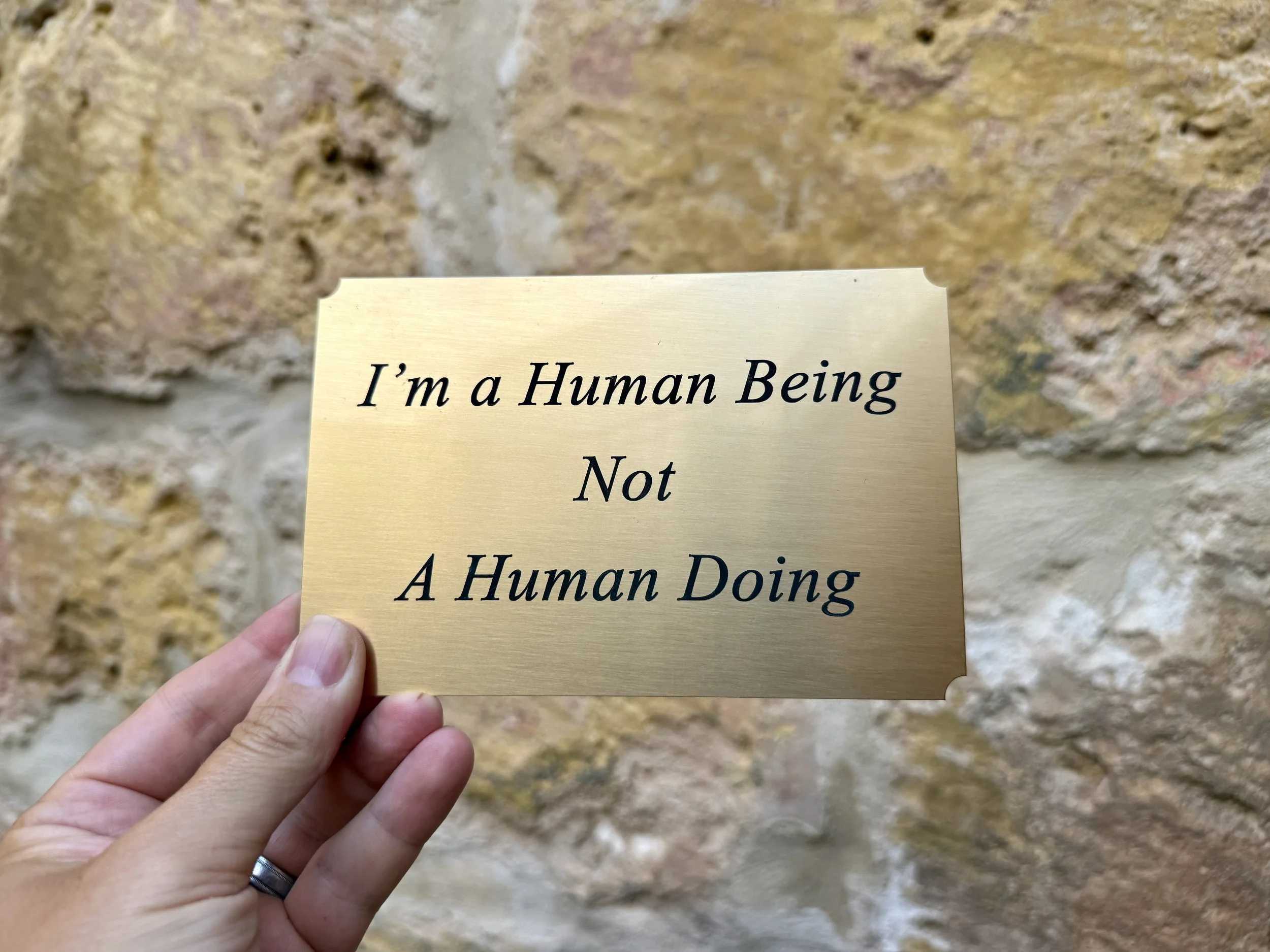
In 2024, thirty years after my uncle's death, at an adaptive leadership conference, I was asked to bring an artifact that symbolized my journey. I immediately thought of one thing: the button. Sadly, my parents no longer had it. But when I became a senior executive, they had its nine words set into a small gold plaque. As I shared it with Ron Heifetz, everything came together.
Now, it sits on the bookcase in my office, just over my shoulder. I consider those words every day. They don't define me; they guide me. They’re a way of asking myself where to put my attention, when, how, and why.
We're leading human beings, managing human doings, designing human systems.
That is complex, and complicated, and genuinely hard. It asks us to act without having all the answers — even as the people around us hope we have them. It asks us to be human.
The playbook seems to be written, but it's always changing. The playbook is change. But so are we. And we lead others not in ignorance or defiance of that, but because of it.
So which matters more? The human beings or the human doings?
Maybe the answer lives in the question itself.