I love the em dash — and I’m terrified of it.
I’ve always loved writing. At eight, I wrote a short story about a cookie monster wrestling with regret after eating a bunch of Brownies (the youngest Girl Scouts) instead of their cookies. Later came poetry and philosophy papers, and then twenty years of federal service: investigation memos, indictments, speeches for presidential appointees and my own keynotes, reports to Congress, and internal newsletters on leadership and organizational health.
There was always a story to tell. Punctuation partnered with me to tell it. Over time, I broke up with my old fling, the semicolon, and found a new love: the dash.
In the past year, though, I’ve had second thoughts about our relationship.
Perhaps those thoughts echo a question many people exercising leadership are facing right now, especially about AI: what holds us through change?
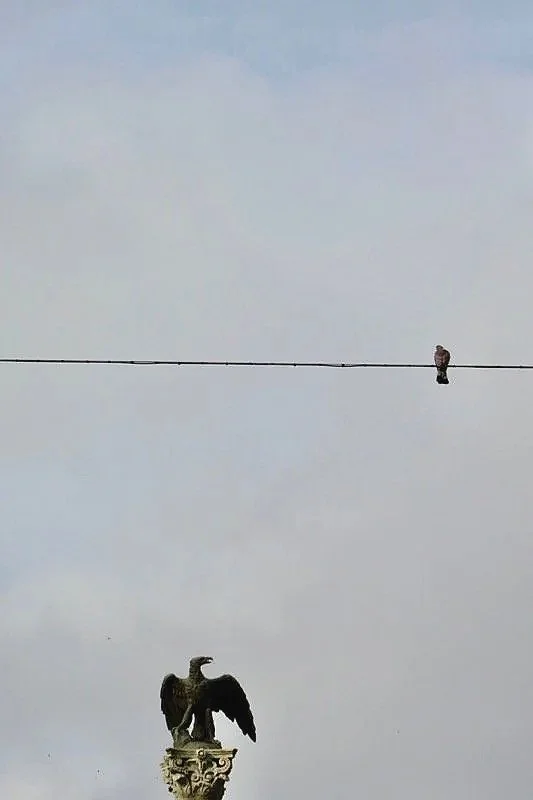
Photograph by Brian Sano
The “ChatGPT hyphen”
Despite decades of practice, I became afraid to use the dash because it was supposedly a telltale sign of writing with AI. To be clear, I love using Claude and ChatGPT as cognitive companions that support my thinking, research, and writing. But I worried others would doubt that my ideas and my writing were mine, which they are. I even began to question my identity, including as a writer.
Like the space a dash takes up, the argument started small. Here’s how it seems to have happened. In October 2024, someone on Reddit asked whether anyone else had noticed how often ChatGPT used em dashes. Within months, recruiters and marketers on LinkedIn were treating it as a shortcut for spotting AI-written text. Younger users nicknamed it the “ChatGPT hyphen,” even though it isn’t a hyphen at all. Podcasts told brands to delete dashes from their ads. Writers who had used it for decades started apologizing for it, or quietly giving it up.
Some pointed out the obvious: these tools learned the dash from us, from centuries of good writing from good writers. Like Emily Dickinson or James Joyce. But doubt remained. By November 2025, OpenAI’s Sam Altman was celebrating a “small-but-happy win.” ChatGPT would finally obey users who told it to stop using em dashes.
What’s the point of the dash?
The dash lacked respect long before that, including in popular books on writing. William Zinsser noted it was seen as “a bumpkin at the genteel dinner table of good English.” Lynne Truss pointed out its awkwardness, noting it shares its roots with the verb to dash: to knock, to hurl, to break.
But let’s consider what it actually does. A period ends a thought. A comma keeps it going. The dash does something else — it stops the sentence without ending it, holding what came before and what comes next. Lingering, without closure.
It’s the punctuation of the in-between, where we wait, moving from where we were, before we know where we’re going.
Ironically or not, it seems to echo the many thoughts and feelings people have generally about the role of AI in our work and lives. This small line has been asked to hold something much larger — our anxiety about AI and what it’s changing in our work, our world, and ourselves.
Have we projected our hopes and fears onto the dash, the way a child projects onto a teddy bear or security blanket?

Photograph by Brian Sano
The teddy bear — holding the space in between
While working with young children in the mid-20th century, pediatrician and psychoanalyst D. W. Winnicott noticed the special attention they gave to the teddy bears and blankets they carried everywhere. These “transitional objects” seemed to help a child move from feeling inseparable from a parent to discovering their own identity. They helped the child learn the difference between “me” and “not-me.”
The teddy bear is objectively real, yet the child also created it, through the meaning they gave it. Winnicott insisted we should never ask the child whether they created it or found it. Leaving that paradox unchallenged is what makes development possible.
Which makes our current suspicion of the dash on point. “Did you write this, or did a machine?” is exactly the kind of question Winnicott argued must not be asked. Sometimes the question matters — maybe in a classroom or a courtroom. But asking it about every dash interrogates the in-between itself. It turns a space for play into an investigation. Who wants to play then?
The teddy bear can also take whatever the child puts into it: comfort and love, frustration and fear, a longing to be seen. To matter. It gets hugged and hurled across the room, brought to bed or left out in the rain. It can take it. That’s its job.
The place where we live
Winnicott believed we don’t outgrow this. We spend most of our lives “neither in behaviour nor in contemplation, but somewhere else.” He called that intermediate zone a “potential space,” a third area of human living between our inner world and outer, shared reality. Between the individual and the environment. It connects and separates us.
This space also supports what Winnicott called “going-on-being.” A baby’s sense of self depends on experience that carries on without too much disruption. When the outside world interferes too much, the baby stops simply being and starts reacting. “After being — doing and being done to,” Winnicott wrote. “But first, being.”
Human beings before human doings.
The dash works the same way on the page. It carries a thought or feeling forward without breaking it, a small piece of continuity in the middle of a sentence. So, naturally, our anxiety landed there when our own continuity started to feel uncertain.
Now, people are seeing AI in different ways, at different times. Some meet it with comfort or curiosity. Others resist it or see it as a threat — to their job, their career, their identity, their legacy.
For example, in one recent conversation, a coaching colleague shared some frustration after receiving advice from family and friends telling him he needs to find a new career as AI would replace coaching within a few years. Indeed, some argue it already can coach at the same standard as Associate Certified Coaches (ACC) with the International Coaching Federation (ICF).
Those feelings live in the in-between too: between our doing and our being, between our inner hopes and fears, and the outer reality we’re trying to make sense of.

Photograph by Brian Sano
Where does leadership happen?
This raises important questions about leadership. Change always does. What kind of leadership does a world being reshaped by AI need? Has leadership itself changed? And how should we rethink leadership development?
Read through a Winnicottian lens, the most valuable question isn’t what, who, or how. It’s where.
Where does leadership happen?
I don’t mean a physical location, so the return-to-office debate doesn’t apply here.
Leadership happens in the in-between.
Just like the teddy bear or the dash, it lives in the potential space: between our inner and outer worlds, between individual(s) and their environment, between the past and the future.
And I don't mean this to be purely philosophical. In fact, it's quite practical. Leadership always involves bringing people from the past to the future, through the present.
The present is where anxiety about change thrives. As one of my teachers, Ronald Heifetz, puts it, people don’t resist change; they resist loss. And David Kessler taught me that loss brings grief. Moreover, those losses or potential losses might not be easy to see. The version of you or the role you’re giving up. The competence and confidence that made work comfortable. The journey from an expert to a beginner again.
With AI, many people are grieving the past and fearing the future at the same time; they’re living mid-sentence. Sometimes, we even judge them for it.

Photograph by Brian Sano
“Good-enough” leadership
Once we understand where leadership happens — in the "in-between" — we can see more clearly how to exercise it and why, including our developing personal and professional relationship with AI.
Winnicott’s exploration of a child’s development offers more insights here too. He found that parents don’t have to be perfect, just “good enough.” Their task is to create the conditions in which a child can work through their thoughts and feelings or whatever comes up in that potential space, as they make sense of their changing inner and outer worlds. To play with and within reality. It’s a delicate space, and it depends on trust.
Good-enough parenting (which Winnicott believed either parent, or others, could provide) plays within a paradox: how to offer challenge and support, both in your presence and absence.
It means being close at times and more distant at others, letting the child fail a little more each time, at a pace they can bear. It’s like teaching them how to ride a bike — eventually, you lose the training wheels and welcome the gravelly scrapes and bruises. It keeps the space open by not imposing the parent’s own thoughts or feelings on the child’s playing. Then, you can invite and enjoy what develops, together.
Winnicott called this a “holding environment.” It doesn’t provide answers or certainty, and it doesn’t always rescue the child. It offers enough stability for the child to play, explore, try, fail, and find themselves. It develops the human being, and the human doing.
Leadership works the same way.
Heifetz brought the holding environment into the practice of leadership. Exercising leadership also involves noticing the level of anxiety people experience in relation to change. Keeping the pressure or heat high enough for them to learn and do hard work, but not so much that it becomes unbearable. It means disappointing people at a rate, pace, and sequence they can absorb or handle.
Gianpiero Petriglieri, whose work first drew me into this field, and Jennifer Louise Petriglieri extend the idea to institutions and organizations themselves. At their best, beyond their mission and vision, they serve as holding environments not only for getting work done, but to support the work of becoming who we are.
That is exactly what’s at stake with leading people through AI. Leadership needs to inspire curiosity — not just about what people do, but who they might be in doing it.
Good-enough leadership protects people’s going-on-being. It helps them make sense of change and find meaning through loss, and grief. That doesn’t mean taking the anxiety away — if we even could. And it’s not just leaving people alone to deal with it. It happens by witnessing it. By seeing it, and seeing them, with curiosity rather than judgment. It holds the space steady enough that people can play in it and try new ways of doing and being.
Taking on that task and role isn’t easy. I know from experience.
In fact, those exercising good-enough leadership often play various parts. Like the good-enough parent, they create the holding environment. And like the teddy bear, they become something people hold onto and project into: the excitement or anxiety, the love and loss, and fear or anger that change stirs up. They get hugged and hurled around. Either way, they have to survive it without retaliating or collapsing.
Late in his life, Winnicott observed something similar in the British monarchy — their essential task was simply to survive. To remain present and poised while a nation and its people projected their love, hate, or other emotions onto it.
Those exercising leadership while holding people through the evolution of AI might have a similar role. We can’t have every answer. We can be there for others.
Besides, the teddy bear isn’t meant to be carried forever. Eventually the child lets go. Dependency yields to development. Even the dash leads us from what was to what’s next. Good-enough leadership holds people well enough, for long enough, so they can stay in uncertainty, be curious about the anxiety it brings, move forward, and learn more about themselves in the process.
The primary task of leadership is holding people through change.
Then…it lets them go.
Playing with the pause
So here’s an invitation. Think about a change you’re living through. Something that has some heat. Maybe it’s your own thoughts or feelings about AI. Maybe it’s a change you have the privilege and responsibility of holding others through, whether you invited or invoked it or not.
Here are some questions for anyone leading human beings through change:
What is the em dash, or the teddy bear, in your team that people are clinging to, or throwing around, to defend against the anxiety that change brings?
What have you stopped doing lately because you were afraid of how it might look?
Where are you rushing to close a sentence that needs to stay open?
Maybe we can all explore the potential space that paradox offers. Between playing and reality. Knowing and not knowing. Human beings and human doings.
Oh, and to clear up any uncertainty, I'll keep using my dashes. Maybe they will serve as a reminder or another invitation to be more curious about what happens within and between us — in the in-between.

Photograph by Brian Sano
References
Altman, S. [@sama]. (2025, November 14). Small-but-happy win: If you tell ChatGPT not to use em-dashes in your custom instructions, it finally does what it’s supposed to do! [Post]. X. https://x.com/sama/status/1989193813043069219
Bustle. (2025). Gen Z has figured out a dead giveaway that you’re using ChatGPT. https://www.bustle.com/life/chat-gpt-hyphen-em-dash-gen-z
Heifetz, R. A. (1994). Leadership without easy answers. Belknap Press of Harvard University Press.
Heifetz, R. A., & Linsky, M. (2017)(Rev. ed.). Leadership on the line: Staying alive through the dangers of leading. Harvard Business School Press.
Kessler, D. (2019). Finding meaning: The sixth stage of grief. Scribner.
Know Your Meme. (n.d.). ChatGPT em dash. https://knowyourmeme.com/memes/chatgpt-em-dash
Passmore, J., Tee, D. R., & Rutschmann, R. (2025). ‘Getting better all the time’: Using professional human coach competencies to evaluate the quality of AI coaching agent performance. Coaching: An International Journal of Theory, Research and Practice. https://doi.org/10.1080/17521882.2025.2510643
Petriglieri, G., & Petriglieri, J. L. (2010). Identity workspaces: The case for business schools. Academy of Management Learning & Education, 9(1), 44–60.
Truss, L. (2004). Eats, shoots & leaves: The zero tolerance approach to punctuation. Gotham Books.
Winnicott, D. W. (1953). Transitional objects and transitional phenomena. International Journal of Psycho-Analysis, 34, 89–97.
Winnicott, D. W. (1965). The maturational processes and the facilitating environment. Hogarth Press.
Winnicott, D. W. (1971). Playing and reality. Tavistock Publications Ltd.
Winnicott, D. W. (1986). The place of the monarchy. In Home is where we start from. W. W. Norton. (Original work published 1970)
Wu, D. (2025, April 9). Some people think AI writing has a tell — the em dash. Writers disagree. The Washington Post. https://www.washingtonpost.com/technology/2025/04/09/ai-em-dash-writing-punctuation-chatgpt/
Zinsser, W. (2006). On writing well (30th anniversary ed.). HarperCollins.