Brian-in-the-mind: Who are we in the minds of others — and how clearly do any of us really see?
Who is Brian Sano?
It's a strange question to ask yourself, about yourself.
Over the years, with my own coaches, coaching supervisors, and through my personal and professional developmental journey, I've wondered how to answer it.
Sometimes the answer has been rooted in family. Son. Then brother. Nephew or cousin. Then Uncle. Now Husband.
Sometimes it has been rooted in work. When I started studying French as a teenager, I was fascinated by the way the language describes one's profession, dropping the article. Je suis avocat. Literally, I am lawyer. Not I am a lawyer.
It became a reality after law school, when I began dating a Parisian woman I'd met there and started using it myself — to myself.
Je suis avocat.
I said it. And somehow I felt it. The role wasn't simply something I did. It had become part of who I understood myself to be. And how others saw me.

Photograph by Brian Sano
Over the years, I earned other identities, mostly related to my job or what I did and who I did it with. Member of the federal Senior Executive Service. Senior Policy Advisor. Director of Organizational Health. Chief Management Strategy Officer. Executive coach (and Professional Certified Coach, or "PCC," within that). Consultant. Teacher.
And I still struggle responding when asked to share my title or biography for speaking engagements and marketing materials.
Role vs. Identity: What makes us who we are?
And then, more recently, after moving from Washington, DC, to Malta, a few new ones appeared. Expat. American — which, interestingly, wasn't an identity I thought much about while actually living in America.

Photograph by Brian Sano
All of which invited me to think again about not just how I describe myself, but who I am.
This month, the question changed even more.
It wasn't just: Who is Brian Sano?
It was also: Where is Brian Sano?
Three people I know well (all Americans, in the U.S.) — a coaching colleague, a former boss, and a mentor/teacher I trust — each said some version of the same thing. Or at least, this is how I heard it.
You left the U.S.
You left us.
Our loss. Their gain.
That surprised me. Because, in my mind, I didn't leave. Or, more accurately, I did… and I didn't.
I had physically left my job and home in Washington, DC, where I lived for the past 24 years, most of my adult and professional life. And I now live in Europe, in Malta. Indeed, something had changed.

Photograph by Brian Sano
But in my mind, something had not.
I did not leave my work in the United States, nor my intention to work with clients there, including in DC. I still work — and intend to continue working — with clients in Washington, DC; New York; and across the U.S., alongside my work in Malta, the U.K., across Europe, and elsewhere.
Besides, this isn't particularly new for me and my colleagues and clients, especially over the last decade.
I've led and worked inside a remote organization over the past two years. And, before that, I was mostly working remotely or teleworking since 2020. I've helped organizations and teams build and sustain strong hybrid and remote teams and cultures, whether employees and contractors were colocated or distributed geographically.
I've been teaching and learning using Zoom since 2014, well before the pandemic. Much of my own professional training has happened remotely, including for coaching and leadership development.
And most of my own coaching clients I've never met in person. Some I've never even seen, as they preferred to work over the phone or without the Zoom or Teams camera.
My business remains a Washington, DC LLC. I get mail there. I maintain my licenses to practice law in New York and Washington, DC. And I remain professionally connected to the communities in which I've worked for years.
Malta is where I currently live. Yes. But despite its historic and ancient fortress walls and coastline boundary, it isn't where my work begins or ends. And I didn't move here to keep people out.
So, with the curiosity of an anthropologist — or my boyhood heroes, brothers Frank and Joe Hardy — I started my internal and external investigation.
I wondered: What role do we play in who we are — or in how others perceive us?
I went looking for clues. I searched my website. My LinkedIn profile and posts. My texts and emails.
What story had I been telling? What were they seeing? Obviously, my close friends and colleagues knew I left. Others shared the news before I could. And yes, I posted photographs of Malta on my social media pages. The sea. Sailboats and sunsets. Religious relics and limestone walls.
I intentionally wrote on my website how I was "based in Malta." Indeed, I have been trying to build a network, community, and support clients here too. I still want to.
But, individually, none of those things specifically said: Brian doesn't work in the U.S. anymore.
Psychological Presence
My physical presence changed. Psychologically, I had moved too.
Something seemed to happen between who I believed I was — and who I was presenting to be — and the "Brian" other people were carrying in their minds.

Photograph by Brian Sano
Their version of Brian had left. Mine hadn't.
And yet, neither version was entirely right or wrong.
As human beings, we make sense of our world by putting the pieces together. By combining the data we have available to us, through our various sense perceptions and faculties. Like building a model from a bunch of LEGO® bricks.
But that's not all. From that, we create a story. First in our minds. Knowingly or not. Thoughts and emotions add various layers on top of what we build.
Here, people seemed to be building different models and stories of “Brian,” from the same bricks.
Perhaps people in my life were projecting their own desires or dreams, even the scary or sad ones. For instance, some might have unconsciously asked me to help contain complicated feelings they might be carrying about America right now. Maybe, that became attached to me, my role, my work, my identity.
Or perhaps I'm projecting myself onto their thoughts or feelings right now. Or who they are.
I don't know. We won't know. And that's not the point.
Organization-in-the-mind
This inquiry reminded me of an idea and term I've appreciated from the Tavistock tradition of group relations and systems psychodynamics: organization-in-the-mind. Often associated with David Armstrong, he claims the term was first introduced by Pierre Turquet as a way to explore the interrelatedness between people and groups, within an institutional setting — particularly a group relations conference.
The idea, put simply, is that we relate not only to organizations as they objectively exist. We also relate to the organizations we carry in our minds. In our associations, thoughts, and feelings — knowingly or even unconsciously. We construct internal versions of them from our own experiences, relationships, stories, emotions, expectations or disappointments, or hopes and fears.
As Armstrong explains, however, "The 'organization-in-the-mind' has to be understood literally and not just metaphorically. It does not (only) refer to the client's conscious or unconscious mental constructs of the organization: the assumptions [they] make about aim, task, authority, power, accountability, and so on. It refers also to the emotional resonances, registered and present in the mind of the client."*
For example, two people could work in the same organization and psychologically be in a very different place. And this goes beyond the location of their desk, their computer's IP address, or where they are on the organizational chart.
This started to shift the landscape for me.
Person-in-the-mind
So, as a part of my investigation, this left me wondering: Do we do something similar with people?
This might simply be a different way of describing the interpersonal dynamics that psychoanalytic and systems traditions have explored for a long time, especially projection and transference, which deserve a more detailed discussion.
I'm still thinking about it. And sorry to disappoint, but I don't have the answers.
But I've found the question useful enough to think about it this way, the "person-in-the-mind."
Or, in this case: Brian-in-the-mind.
Maybe there is more than one “Brian” here. Enough to feed Schroedinger's cat(s). And I'm already busy enough as it is!
There's not only the “Brian” I see and understand as myself. Beyond how my biography, LinkedIn profile, or website describe me.
“Brian” as he exists inside someone else's mind. In many people's minds. Like a new universe of "Brian" LEGO® minifigures!
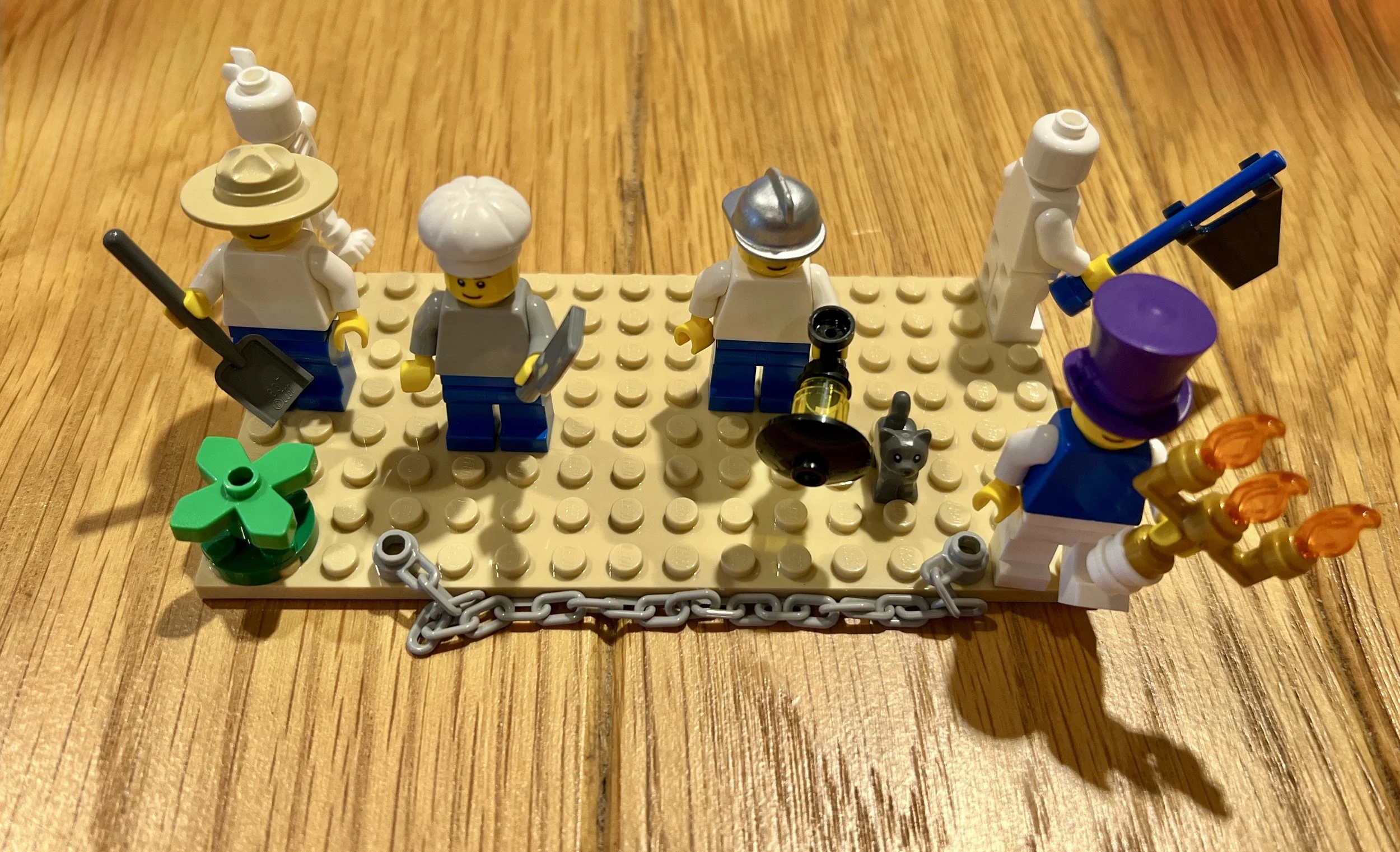
LEGO® Serious Play® model representing roles I’ve played.
Based on things I've said or done. Experiences we've shared. Roles I've occupied. Expectations people developed. Things I remind them of. Things they hope I might be. Things they fear I might become.
Put together, those pieces present a psychologically whole person. A person who can begin operating in someone else's mind, independently of the person I experience myself to be.
That's different from: What do they think of me…?
Or: Do they want to work with me…?
And even (a harder one for me): Do they like me…?
Leadership-in-the-mind
This exploration led me to wonder how this relates to the work of leadership.
Versions of ourselves live on once we've left. Whether it's the country or the conference room. And they arrive before we do too.
How does this help or hinder us as we try to build, maintain, or rebuild trust? Or as we try to gain and use our authority — formally or informally. Or our power? Dealing with conflict? Or how we consider and contain the difficult emotions people have as we lead them through change, including loss and grief?
Interestingly, despite these deep psychological or philosophical questions, I came to see it as an operations question:
How am I operating inside someone else's psychological organization?
What if leadership isn't only about how we operate within organizations, but also seeing and making sense of how we are operating within the organizations other people carry in their minds? Or how and where they organize us, in their minds?
Strategically, what's at stake if we do not see the version of ourselves others have about us psychologically, the "person-in-the-mind" or the "leader-in-the-mind?" And, what might we gain when we do?
Seeing clearly
That brings me back to why I think of leadership as an art of seeing.
It's not about seeing perfectly. And it's not about finding a way to free ourselves permanently from other people's assumptions, expectations, or projections. Good luck with that.
Rather, I find it involves developing the ability to notice and see more clearly. To become curious not just about what we see or how people see us — it's about how we see. Including how we might see and learn from the dozens, hundreds, or even thousands (maybe even millions) of versions of us people have in their minds?
And, perhaps, leadership requires the ability to bear what clearer seeing reveals — including how others see us. That takes courage. Because sometimes the story we've built is easier to live with than the ambiguity beneath it.
So, who's right about Brian Sano? Maybe we all are….
But for the record, I'm living in Malta, but still work in the U.S., and elsewhere.

Photograph by Brian Sano
Wherever you are, there's always a chance to see more clearly, here, now.
Reflections to consider
I invite you to join me in exploring some questions I'm now asking myself:
What version of you is currently operating in someone else's mind? What roles do you play in their psychological organization?
What evidence have they used to build that version/person? What’s right/wrong?
Which parts of the story have you consciously communicated — and which ones have they completed for you?
What might their version of you reveal that you would rather not see?
Who are you carrying in your own mind?
What have you projected, assumed, or filled in about them?
What's possible if you saw things a little differently?
Simply put: How might we be more curious to see more clearly?
*Armstrong, David, edited by Robert French. Organization in the Mind: Psychoanalysis, Group Relations, and Organizational Consultancy. Routledge, 2019 (first published Karnac Books, 2005).