What Does Curiosity Feel Like?
A reflection on role, authority, leadership, and organization from the 79th Leicester Conference
"You just have to experience it yourself."
That's what some people told me when I tried to find out more about the Leicester Conference, the “mother” of group relations conferences, a 14 day, residential conference/retreat outside of London, hosted annually by the Tavistock Institute of Human Relations (The Tavistock Institute). It has been happening at least once a year since 1957! So something must be working.
I discovered the Tavistock Institute and The Leicester Conference while studying the work of Gianpiero Petriglieri, Associate Professor of Organizational Behavior at INSEAD, especially on the overlap of leadership, identity, and “systems psychodynamics.”
As I studied the field more, it reignited my passion for existential philosophy and interest in using experiential learning in leadership development. The myth and mystery of condensing this into a living, breathing, intense “conference” experience also drew me closer into a new world – and into a new way of being, seeing, and leading.
I read what I could find and learned from people who had been – well, sort of. Their answers were helpful and kind, but I still sensed a vagueness or lack of clarity. But it didn’t seem like they were hiding anything. Rather, even for them, it seemed hard to put into words. Honestly, it’s hard for me now too.
The Leicester Conference marketing materials offered some guidance:
A temporary organisation is created, in which all members and staff co-create the culture and practices of the organisation as it unfolds…We look at everything that happens within the organisation and bring to the surface what meanings may be embedded within the group behaviours, as they happen.
The brochure added – and as I later found out myself – “There is nothing quite like it.”
Crossing a boundary
This intrigued me, especially as I had a leadership role as an executive for a temporary organization within the U.S. Treasury Department, set up in 2009 – for a limited time – to oversee the federal bailout programs from the global financial crisis. At the time I considered attending the conference, I had started working with another temporary organization established to oversee U.S. relief programs created during the COVID-19 pandemic, also with a sunset date.
And, as I’ve written elsewhere, this seemed to align with my view of leadership, focusing on the human beings along with the human doings, within and across human systems.
Something else stood out. And it made me slightly uncomfortable.
As the materials also explained: “The conference is designed to surface our assumptions, fantasies and myths about organisational life.” This included the unconscious dynamics happening within and between people and groups. What we couldn’t see or maybe didn’t want to talk about. What might be happening “in the here and now.”
Before jumping into the deep-end, however, I knew I needed to dip my toes in the world of group relations conferences (GRCs) first.
During the pandemic, I attended my first GRC, hosted by International Group Relations China. It was online. One week, for many hours each day, after I finished a full day of work. It was mostly in Chinese, with “cultural interpretation” available in English (I don’t speak any dialect of Chinese). But I understood the human emotions people expressed and shared. I felt the joys and pains that I witnessed. Their loss. Their grief.
Don’t tears speak in a universal language?
Laughter too?
I saw what it meant to be human – to authorize yourself to take a risk and be vulnerable. To share your thoughts and feelings in front of other human beings, including strangers, even through screens, around the world, across cultures. And I appreciated how the team directed, administered, and consulted to the members, challenging and supporting us. They held our attention and created a space in which we could explore these difficult topics together, across many boundaries.
I then saw similar leadership – from management and members – in person, at a weekend-long GRC in Manhattan at Teachers College, Columbia University, co-sponsored by the Tavistock Institute.
I didn’t stop there. I began training on how to consult within small study groups at GRCs.
I was hooked. I was ready to dive deeper. Much deeper. Yet, I wasn’t really sure why. But I saw how.
So, I applied to join the 2024 Leicester Conference, focused on: Studying Stuckness, Movement, and Hope. It came at a moment in my life when I felt stuck and hopeless in my professional career. I needed a change. Some movement. Unfortunately – or not – I had to postpone attending the 2024 conference for personal and professional reasons.
I reapplied and was able to attend the 2025 Leicester Conference, with another personally-relevant theme: Learning in Fragmented Environments (LIFE).
Life, so to speak, would never be the same.

Photograph by Brian Sano
What roles are we pushed or pulled into?
So what happened? And what did I learn? How did life change?
It sounds like the start of a bad joke, but as I sat down to write this, I wondered: If an anthropologist walked into a room at the Leicester Conference, what would they see?
People talking and being talked at or “consulted” to. Listening and laughing. Maybe even crying or yelling. Singing and dancing. Walking and writing.
They’d see human beings, being human.
Leaders and coaches. Psychiatrists and psychotherapists. Trainers and teachers. With our different backgrounds and identities, personal interests, family histories. And all our fantastic, unique qualities and flaws. Sharing common pains and struggles, despite the dozens of countries and professions we came from.
The brilliance, beauty, and perhaps brutality of the Leicester Conference was how that journey continued formally and informally for 14 days. We shared the same space with each other while eating, sleeping, walking between sessions – even on local breaks to the park or pub or riding together for a quick day off to London. It intensified the experience and the emotions. It unveiled and invited our humanity.
It also encouraged me to explore different roles I played. Those I took up, as I normally would, especially with respect to leadership and authority.
But I struggled. I found myself contemplating the pros and cons of each role. The gains and losses of each. For the other members, management, myself, and the group or system as a whole. Maybe even the larger systems we lived and operated in. After all, I hoped to leave a lasting impact in people’s hearts and minds long after the conference ended.
I remembered that this was also a learning environment, a laboratory of sorts. I also felt invited by the design of the conference, the management, and my fellow members to step outside of my habitual patterns, to try new things. To get uncomfortable. Maybe, I thought, that could inspire or encourage others to do the same.
Nonetheless, I tend to overthink and overanalyze things. I’m a recovering perfectionist. (And I’ve already re-written and edited this for many hours more than I probably should have). Four years formally studying philosophy and then three years studying law and two decades of practice after that will do that to you.
In the conference, I found myself strategizing and often agonizing over simple decisions, especially when to speak up or remain silent – knowing I could exercise my own authority and leadership either way.
At times, I wondered or worried about what people expected from me at the conference. What role should I play? Should I support the management team, especially the co-directors and consultants? Or the members? Should I challenge one group vs. the other? When? How? Why?
Sometimes, for me, exercising authority or leadership felt like speaking up. Sometimes, it seemed silence worked better. How I decided was unclear. I was curious and care-ful. Why did I speak up when I did? I tried to notice what was happening inside me – in my mind and in my body. Why was my heart beating so fast? What data did that provide? How could I forward the group’s action and deepen our learning?
I was also mindful that my role might get mingled with my identity, or how people saw me – unconsciously or knowingly. Whatever role I took up, I remained an American, white man, lawyer, senior executive in the U.S. government. I was an executive coach, organizational consultant, focused on leadership development.
In many work or learning environments, people tended to trust me quickly. My reputation or position spoke for itself and preceded me. People looked to me for guidance or support, as if I already knew or had the answers and could show them the way through uncertainty and change. Others seemed to reject me or projected and transferred other feelings or experiences onto me because of these identities or roles.
I assumed the same would happen at the conference. Maybe it did. Of course, I could and will never know. Besides, how I acted either way remained in my control. As did how I responded internally and externally to others.
Regardless, my contemplation and confusion reminded me of a similar explanation of communicating and not communicating by D.W. Winnicott, a prominent British psychoanalyst in the mid-late 1900’s: “It is a sophisticated game of hide-and-seek in which it is joy to be hidden but disaster not to be found.”*
I felt both.

Photograph by Brian Sano
How much time do we have?
Like other GRCs, every session of the conference adhered to a specific timeframe. A direct start, on time. A hard stop. Sometimes it was a relief…other times a disappointment. Some days, sessions flew by. Others seemed to last forever.
In fact, it felt like time was always lingering in the background – like another consultant or member of the management team observing or influencing the group as a whole; or another member like me, changing alongside us.
This reminded me: we were always co-creating a “temporary” organization. Moment-by-moment. One that would end, whether we remembered that or not. I tried to bring awareness to this, suggesting how similar this was to our own temporary lives. Lives that would end, just like the conference.
I thought: time is a terrible thing to waste. And yet, it terrifies us.
I wondered if I went too far. I still do. Maybe death – and our anxiety about it – was joyfully hidden. But, I felt like it would be disastrous if we did not surface it – if loss and grief were not witnessed or found. If they were not part of the conversation. I didn’t want to lose the opportunity to explore that with others. I still don’t.
Besides, how much time do we really have?
What role do play and curiosity have in leadership?
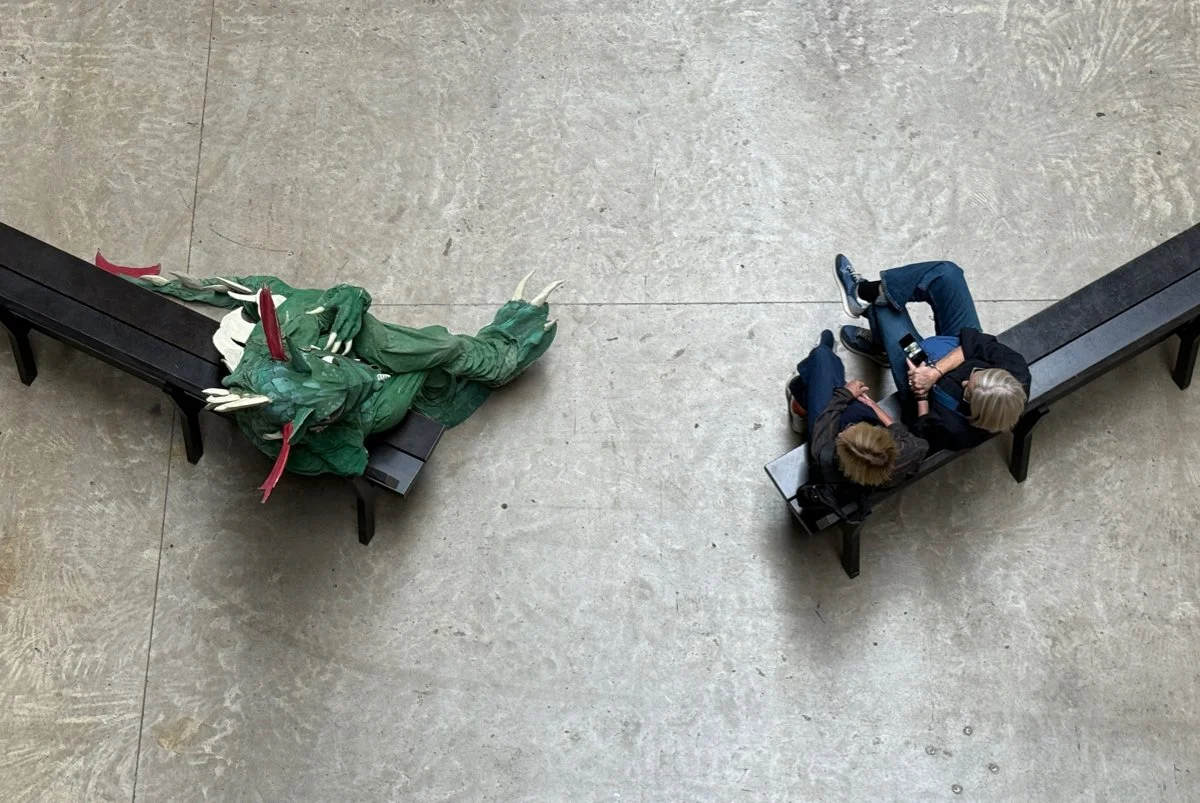
Shifting strategy, I tried to explore these joys and pains of our human relations another way – with a sense of curiosity and playfulness. Others joined me.
Looking back, I think we were really curious about what would happen if we spent more time co-creating an environment that helped us put our shields or arrows down to be with each other – to play with and against each other. To spark more playfulness in the system. And so we did. Of course, doing so still invited other ideas, projections, roles, and emotions.
Even now, I continue to wonder, what role does playing have in leading and learning? What might playful leadership look like? When could it be helpful? Or inappropriate? And what’s the difference between being playful and being curious?
Photograph by Brian Sano
Honestly, for me, including a playful approach to the conference’s primary task helped. I didn’t want to sacrifice the deeper inquiry I started alone and with others, but it was a breath of fresh air.
It reminded me that the practice of leadership also requires us to not take ourselves so seriously. That seems to be the source of much of our human suffering, limiting our leadership, authority, and ultimate success or positive impact.
Building on that, toward the end of the conference, I took on a role with a colleague to explore and represent curiosity in the system. Where was it present? Or absent? How, when, and why did it help? And where was it needed?
Walking the talk, and being curious ourselves, we asked for some advice from a consultant to learn where and how we could best focus our efforts.
While applauding our intention, and admiring our talking and thinking positively about curiosity, he invited us to be curious about curiosity.
This included considering something I did not think of: What does curiosity feel like?
In our bodies? In others? Within and between groups? Within and across the system we were co-creating?
The question stayed with me the rest of the conference…and it probably will forever.
How might I be wrong?
As the conference ended, we had an opportunity to share our learning, thoughts, or feelings out loud. I reflected on a question I encountered while studying adult development theory with Jennifer Garvey Berger and her colleagues at Cultivating Leadership: How might I be wrong?
I shared with everyone that I often ask myself and my coaching clients to consider that question. But I seemed to forget it over those 14 days. I stopped asking. Maybe I was avoiding it unconsciously. I admitted that I could have asked it more during the conference too. I still can.
In March 2026, The Tavistock Institute invited me to speak on a public webinar about my experience at the conference, as they prepared for this year’s 80th conference. I’m not sure exactly what I shared or if it was helpful.
Revisiting it now, I think the Leicester Conference helped deepen my curiosity about human beings and about myself.
Even though we probably share many hopes and fears – existentially, or, at least in theory – we will never know what other people have been through or are currently thinking or feeling. I will never know. I see that now.
Regardless, we can still help and hold them through change. We can be there, witnessing whatever is happening, here and now. We can be more curious about how they experience change and uncertainty through a lens of loss and grief. It might even bring up old wounds.
Maybe this is what makes exercising leadership and authority exhilarating and also exhausting. Maybe learning happens on the other side.
Looking back and considering what I learned over the past year, I’ve come to think of leadership as an art of seeing. It’s a practice…not a perfect. It relies on a sense of playfulness and curiosity. It’s a more advanced, developmental, adult version of “hide-and-seek.” It involves appreciating and wondering about the potential unconscious dynamics impacting any group and how we are being human, together. It’s alive. It’s always timely and temporary. And it includes death.
So in a way, leadership begins where certainty ends.
Even writing this over the past few weeks, I find that it’s still hard to put what I learned – and am still learning – into words.
It should be.
Exploring human relations should be hard. Because being human is hard. It’s messy, complex, and complicated. And we each do being human differently. It’s like navigating a roundabout, without signs, on those old English country roads I travelled to and from the Leicester Conference.
I’m writing something about an ending. This piece will outlive me in some form. But perhaps the real death happens if and when I stop learning from my experience. I know my views will continue to change. Maybe the death of development is the loss I fear or grieve the most.

Photograph by Brian Sano
I’m still not really sure why I’m writing this or who might benefit from it or how. Maybe that’s another role the system is pulling me into or that I feel pushed toward. Obviously, I’m open to exploring that and hope it can be of benefit to others. It might attract people to this work. It might terrify and turn them away.
Maybe that’s what curiosity really feels like…here, now.
Further reflection:
Regardless of whether you ever attend or attended the Leicester Conference or any GRC, I invite you to join me as I continue to learn and grow.
Here are some questions to begin or end with:
What role does curiosity play in leadership?
What does curiosity feel like, for you?
What’s really happening, here…now?
How might we be more curious and play with the temporary organization of our lives – at work, at home and in our human relationships there and in between?
How might I be wrong…?
* Winnicott, D.W. “Communicating and Not Communicating, Leading to a Study of Certain Opposites,” in The Maturational Processes and the Facilitating Environment. Hogarth Press, 1965.
If you’re curious to explore these feelings more, together, let’s have a conversation.